Agentic Board Deck
The Problem
Board reporting is supposed to create clarity.
Instead, it creates friction.
Finance teams rebuild the same KPIs every month. Numbers are exported from ERP systems, adjusted in spreadsheets, copied into slides, and manually reconciled. Each metric exists in multiple versions — depending on who calculated it.
By the time the board meeting happens:
- The numbers are already outdated.
- The narrative is written manually under time pressure.
- Variance explanations are reactive, not structured.
- Confidence depends on who prepared the deck.
The real issue isn’t the slides. It’s that the board pack is not a system.
It’s a monthly reconstruction exercise.
What Actually Happens
A few days before the board meeting, the process starts again.
- Data is exported from the ERP.
- Someone updates the KPI model.
- Spreadsheets get duplicated “just to be safe.”
- Slides from last month are copied and edited.
- ARR is recalculated.
- EBITDA is reconciled.
- Cash is double-checked.
- Someone asks, “Are these numbers final?”
Comments are written manually to explain performance. Variance explanations are assembled from memory, Slack messages, and fragmented analysis. If one number changes, three slides need to be updated.
There is no single system generating the story.
There is a sequence of manual steps, owned by individuals, repeated every month under deadline pressure.
And everyone hopes nothing breaks.
What It Should Look Like
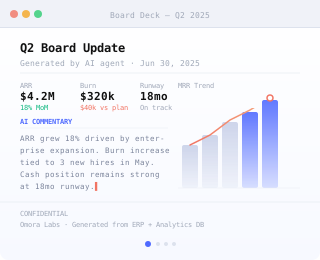
Board reporting should not start three days before the meeting. It should already exist — continuously updated, ready to present. Here's what a board-ready deck looks like when it's generated from a system:
Financial Statements — ARR, MRR, cash position, expenses — all sourced directly from your ERP. No manual export. No reconciliation.
KPI Dashboards — Churn, CAC, runway, burn rate, growth velocity. Calculated once, in a governed model, updating daily.
Variance Analysis — Not "numbers are different." Actual structure:
- Revenue is $200K below plan. Why? (Product mix shift, timing delay, or pricing issue?)
- Burn is $50K higher. Why? (Headcount adds, tool spend, or one-time cost?)
- The system shows you the driver, not just the gap.
Narrative — Written by the system based on what actually changed:
- "ARR growth decelerated 15% due to lower-than-expected sales velocity in enterprise segment. We're addressing this with [specific actions]."
- Not assembled from memory. Derived from performance data.
When the board asks a question, the answer is already structured in the deck.
How It Works
Connect your ERP
Your ERP connects to an analytics database. Your data flows in automatically — no exports, no manual uploads. One source of truth.
Build the charts
You (or we) set up charts and dashboards in whatever BI tool you prefer. Revenue trends. Burn rate. Cash position. Variance analysis. These update automatically as new data arrives.
Define the deck
You decide what goes on the board deck. Which charts. Which metrics. Which commentary sections. You're in control of the narrative structure.
Pick your AI model
Choose which AI model generates the written commentary — OpenAI, Claude, or another provider you prefer. We connect to it, feed it your data and variance drivers, and it writes the narrative.
Launch
The system runs. Every day, it pulls fresh data, updates the charts, generates the narrative, and assembles the board deck.
By the time your board meeting arrives, the deck is ready. This morning's numbers. Real analysis. No scrambling.





What Changes
Before
- Board deck rebuilt manually every month
- Variance explanations improvised under deadline
- Multiple spreadsheet versions create confusion
- Board questions trigger investigation mode
- CFO operates from reaction, not control
After
- Board deck generated automatically from source data
- Variance drivers detected and explained by the system
- One governed version of truth across all metrics
- Board questions answered from structured analysis
- CFO operates from strategic position, not crisis management
The Real Benefit
Finance stops being defensive and becomes strategic.
When the board pack is generated from a governed system — not assembled from spreadsheets — everything changes.
The deck is ready days earlier. No manual work. No spreadsheet grind. No reconciliation delays.
Because the numbers are accurate and already explained, the board trusts what they're seeing. They ask better questions. You operate from control, not crisis. Stronger board conversations. Better strategic decisions. Finance that's fast and reliable.
Why This Matters
At board level, trust is currency.
If the numbers feel unstable, every decision slows down. If definitions change month to month, credibility erodes. If explanations are reactive, leadership looks unprepared.
Board reporting isn’t just communication. It’s signal quality.
When your metrics, narrative, and financials are generated from a single governed system:
- Decisions move faster
- Confidence increases
- Strategic conversations replace reconciliation
- The CFO operates from control, not defense
In high-growth or capital-constrained environments, this difference compounds.
Because when the board trusts the system, they trust the operator.
The System You Own
Here's the important part: You own this completely. This isn't another tool you're locked into. This is your system, your code, your data. You control it. If you want to change it, you can. If you want to move it, you can. No vendor lock-in. It lives in your infrastructure. Your data never leaves your control.
Next Steps
Want to see what this could look like for your business? Or explore the docs? Check below.